Start with a question, not a conclusion
A documentary project often begins with curiosity about a place, group, or shared experience. Turn that curiosity into an open question before making a shot list. “How do people use this neighborhood’s public spaces?” leaves room for discovery. “This neighborhood is disappearing” assumes an answer you may not be equipped to support. Your initial question can guide research without dictating what the photographs must prove.
Write down what you already know, how you know it, and what you are only guessing. Notice where your knowledge comes from: a brief visit, someone else’s account, or your own experience. A community is not a single viewpoint. People who live, work, study, or gather in the same place may describe it differently, and those differences can help you refine the story.
Build context from more than one perspective
Begin with materials that are available without intruding on anyone: local publications, public archives, community organization pages, event notices, maps, and accounts created by people connected to the place. Each can suggest useful questions, but none should stand in for the whole community. Pay attention to who produced a source, whose experience it centers, and what it leaves out.
Look for practical context as well as background. When is a public space busy, and when is it quiet? Is an event intended for a broad audience or a close-knit group? Are there places where photography could interfere with work, worship, care, or rest? You may not be able to answer these questions from a distance. Make a list of what to ask when you arrive rather than filling the gaps with assumptions.
Make contact without treating access as permission
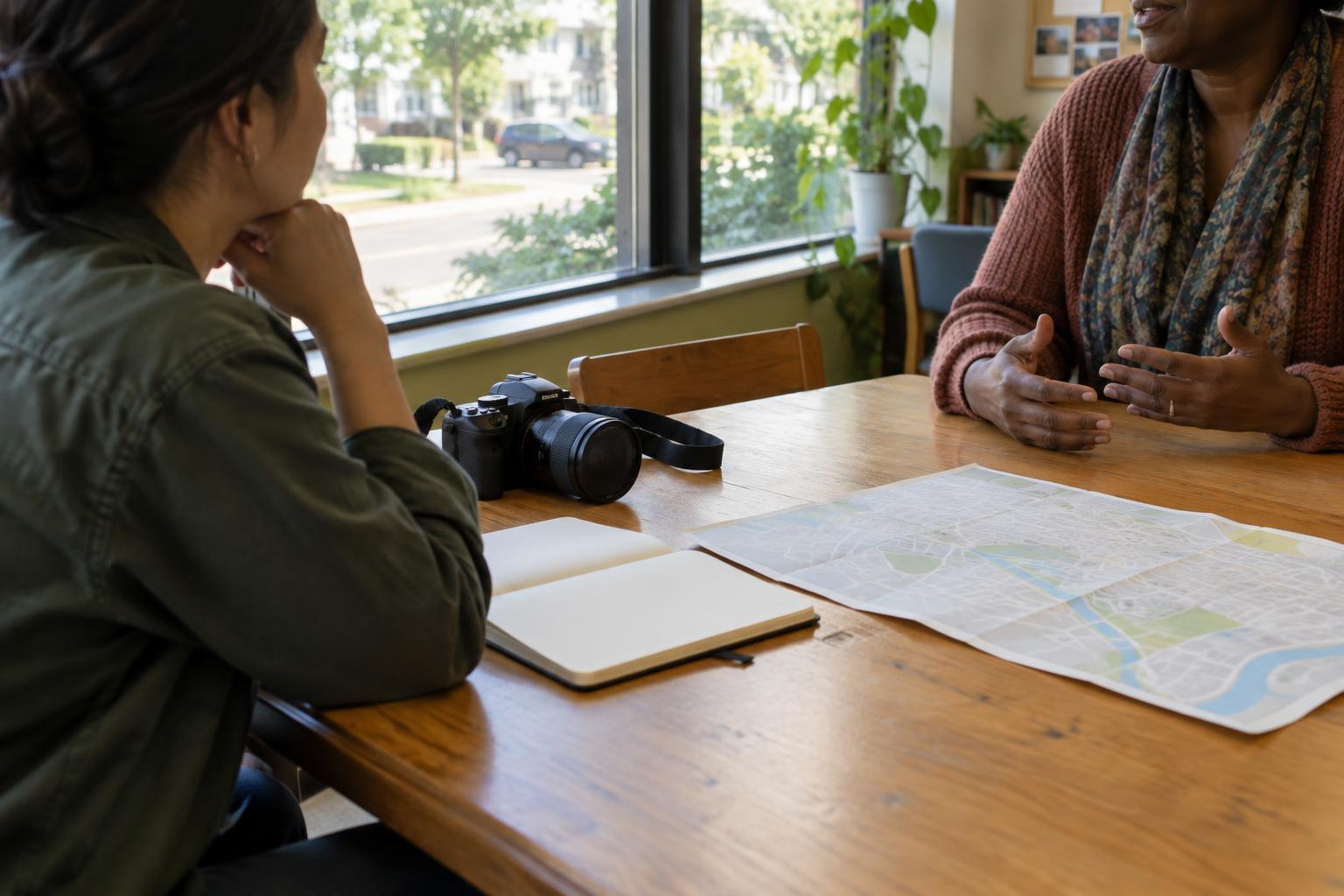
If your project involves an organization or recurring activity, a brief introduction can be a useful first step. Explain who you are, what you hope to photograph, where the work may appear, and whether you can offer participants a chance to ask questions. An organizer may help you understand an event, but their welcome does not automatically mean every person present wants to be photographed.
Give people a meaningful chance to decline, especially when you are working closely or photographing someone in a vulnerable moment. Consent is an ongoing conversation, not just a form or a single yes. Be clear about what you can and cannot promise, including whether you can control how an image is shared after publication. If someone asks you to stop, pause and listen. Even where photography is permitted, the ability to take a picture does not settle whether taking it is respectful.
Plan for what the frame cannot show
A photograph records a narrow slice of a situation. Before shooting, consider what a viewer might infer from that slice without further context. Could a routine gathering look like a crisis? Could a portrait make one person appear to represent everyone? These questions do not mean avoiding difficult subjects. They mean watching for images that invite stronger conclusions than your reporting supports.
Keep a simple field notebook. Record the location, what was happening, how you learned a person’s name or role, and which details still need checking. Separate what you saw from what someone told you and from your own interpretation. If identifying a person or location could expose them to unwanted attention, consider that risk before publishing, not just when writing the caption.
Review the story after the photographs are made
Research continues during editing. Look across the whole set: who appears, who is missing, and which moments you repeatedly selected. A technically strong image may be a poor choice if it distorts the broader experience you observed. Captions should identify what you can verify and avoid assigning motives or speaking for people. When a detail matters but remains uncertain, check it or leave it out.
If appropriate, follow up with participants about names, activities, or other factual details. This is not the same as handing over editorial decisions, but it can catch errors and clarify context. Be willing to change your plan when new information challenges your original idea. Researching a community well does not guarantee a complete story; it gives you a better way to recognize the limits of the one you can tell.