What the two modes actually do
Autofocus mode determines what your camera does after it finds focus. In single autofocus, often labeled AF-S or One-Shot AF, the camera focuses once and generally holds that distance while you keep the shutter button half-pressed. This suits a subject that remains at roughly the same distance from the camera, such as a building detail, a tabletop object, or a person posing.
Continuous autofocus, often labeled AF-C or AI Servo AF, keeps updating focus while you maintain the focusing action. It is designed for a subject whose distance changes, such as a person walking toward you. These names and controls vary by camera, so check what your own camera means by each setting. Neither mode guarantees a sharp photograph: the camera still needs a usable target, and your shutter speed must be fast enough for the motion you want to freeze.
Choose based on changing distance, not just movement
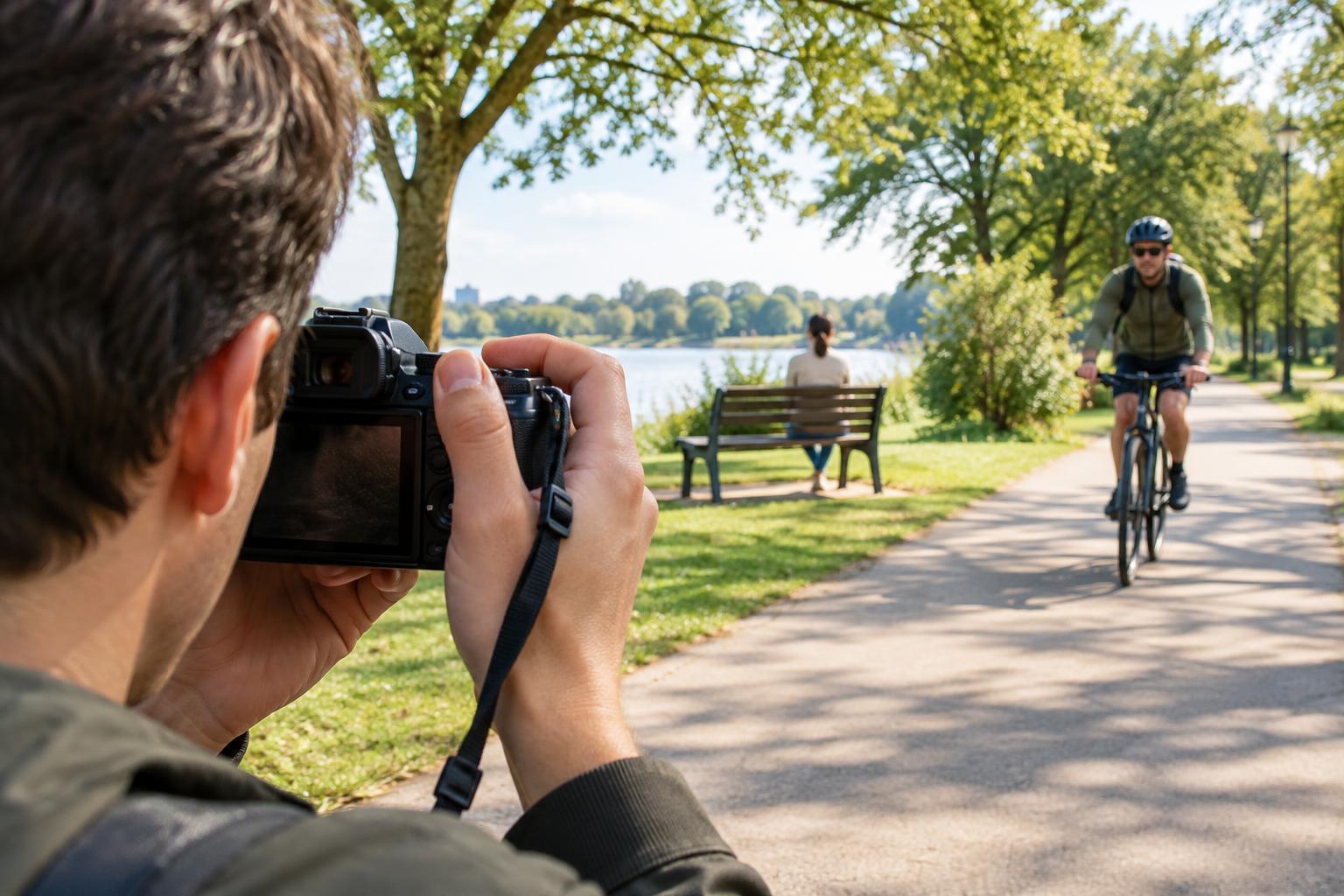
The key question is whether the distance between camera and subject is changing. A person standing still while you photograph a portrait is a straightforward case for single autofocus. If that person begins walking toward you, continuous autofocus is the safer starting point. A cyclist moving across the frame may remain at a similar distance for a moment, but continuous autofocus can help if their path curves or your camera position changes.
A subject can also be still while you move. If you step forward to refine a close-up, the focus distance changes even though the object does not. Refocus after you settle into position, or use continuous autofocus while adjusting your framing. At close distances and with a shallow depth of field, small shifts can make a noticeable difference. When unsure, make a short test sequence and inspect whether the intended detail, such as an eye, is sharp.
Pair the mode with a useful focus area
Autofocus mode answers when the camera updates focus; focus area helps determine where it looks. For a still subject, a small selectable focus area can give you deliberate control. Place it over the feature that matters most, such as a subject’s near eye in a portrait or the lettering on an object. A broad automatic area may instead select a closer or higher-contrast part of the scene.
For a moving subject, a wider area or a tracking option may make it easier to keep focus as the subject shifts within the frame. If your camera offers subject or eye detection, treat it as a helpful aid rather than proof that the intended subject is selected. Check the focus indicator, especially when several people overlap or something passes in front of your subject. If tracking becomes unreliable, try a simpler area that you can keep over the subject yourself.
Avoid common focus and motion mix-ups
A soft photograph is not always an autofocus failure. If the whole frame appears smeared in one direction, camera movement may be the cause. If the background is sharp but a moving person is blurred, the shutter speed may be too slow for that movement. If a different object is sharp, the camera may have focused on the wrong target. Looking for what, if anything, is sharp helps you decide which setting to change.
Single autofocus works well with focus-and-recompose when the subject and camera stay in place, but recomposing changes the camera’s angle and may shift the intended focus plane. This is more noticeable at close range or with shallow depth of field. Moving the focus area onto your subject is often more dependable. Continuous autofocus can struggle when a subject briefly disappears behind an obstacle; keep following the subject, then confirm that focus has returned when it reappears.
Build a quick decision routine
Before shooting, identify the feature that must be sharp and ask whether its distance from you will change. For a settled scene, start with single autofocus and a carefully placed focus area. For an approaching, retreating, or unpredictable subject, start with continuous autofocus and an area you can keep on that subject. Then choose a shutter speed that suits the motion and take a few frames to check the result.
Your camera may also offer an automatic mode that switches between single and continuous focusing. It can be convenient, but its decision may not match your intent in every scene. Practicing the two modes separately makes their behavior easier to recognize. The aim is not to use the most advanced setting; it is to make a clear choice about what should be sharp, then adjust when the subject or your shooting position changes.