A photograph shows a view, not a headcount
A photograph can be strong evidence that a crowd occupied a particular place at a particular moment. It may show the gathering’s character, the space people used and how closely they stood together in the visible area. But a single image usually cannot establish how many people attended an event. Attendance refers to people, while a photograph records only the light reaching a camera from one viewpoint during a brief interval.
That distinction matters when an image circulates with a precise number attached. The number may come from a separate counting method, a rough estimate or an unsupported assertion. The photograph alone does not tell you which. A useful first question is not “Does this look like the claimed number?” but “Which people, places and moments does this image actually include?”
Framing and perspective change the apparent size
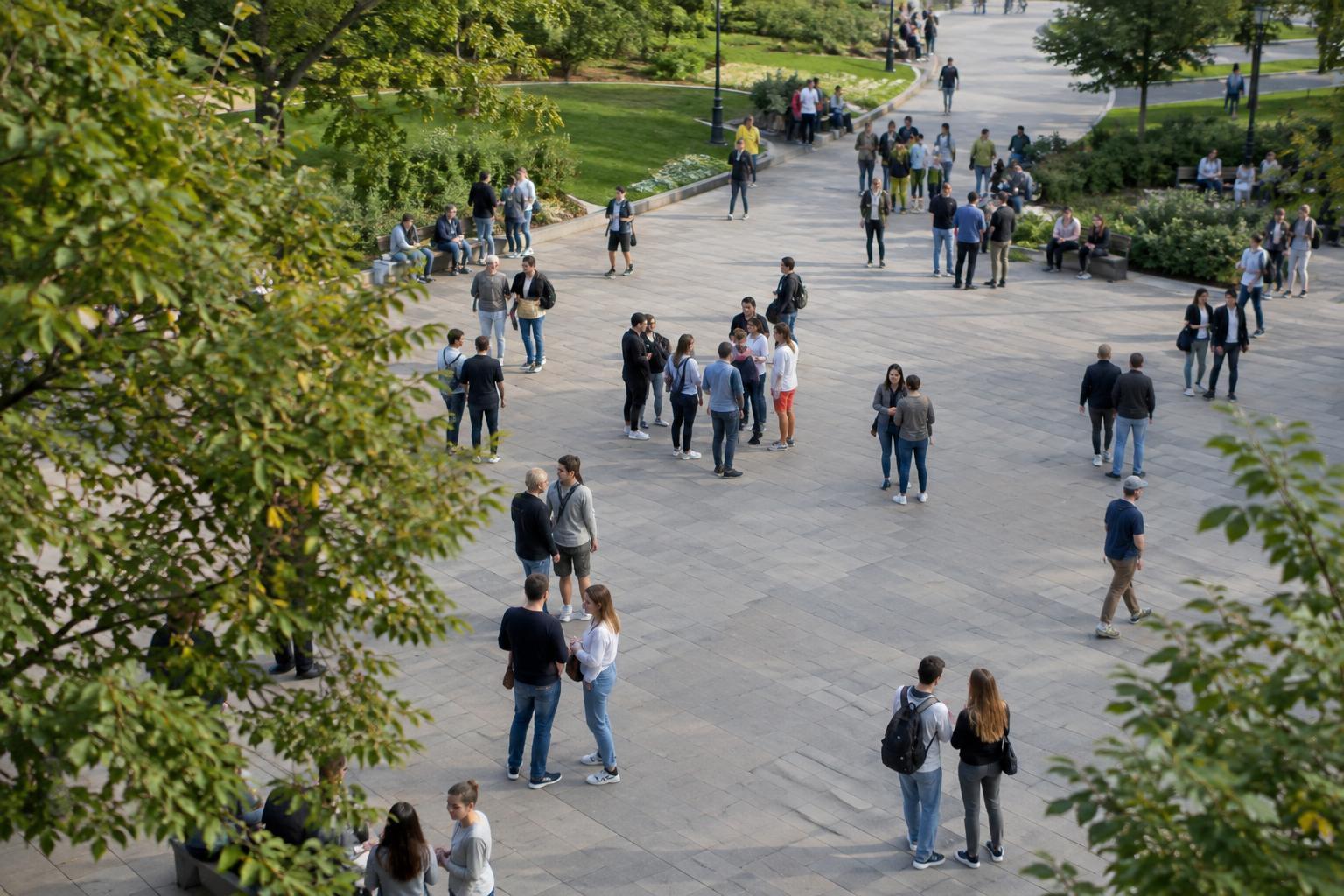
Every frame has boundaries. People beyond its edges, behind buildings or inside nearby spaces are absent from the picture. A tightly cropped image may make a gathering appear to fill the entire available area; a wider view may reveal empty space around it. Neither view necessarily shows the full event. Even an overhead photograph can omit adjoining streets or entrances unless its coverage is known.
Camera position also affects perception. A low viewpoint compresses rows of people visually because those in front hide those behind. A high viewpoint can reveal more ground but may make individual people hard to distinguish. A long lens can make separated groups appear closer together, while a wide lens can emphasize nearby gaps. These effects do not make the photographs false. They mean that apparent fullness is not a direct measure of attendance.
Visible area does not have a single crowd density
One way to estimate a crowd is to measure the area it occupies and apply an estimated number of people per unit of space. A photograph may help identify some occupied areas, but the method depends on assumptions that the image cannot always resolve. People may stand shoulder to shoulder near a stage and spread out near exits. Trees, signs, vehicles and shadows may obscure patches of ground. What looks filled from one angle may include open walkways or barriers.
Distance introduces another problem: individual figures can merge into texture, making it difficult to separate people from objects or from one another. In a dense foreground, some attendees may be hidden entirely. As a result, counting visible heads will usually miss people, while treating every occupied-looking patch as equally dense can overstate a total. A careful estimate needs a defined area and a reasoned range of densities, not just an impression that a scene looks packed.
One moment is not the whole event
A photograph freezes a moment, whereas people arrive, leave and move throughout an event. An image made before a gathering reaches its busiest point may underrepresent its peak; an image made at the peak cannot show how many different people came over the full duration. Those are distinct quantities: the number present at one time, the largest number present at once and the total number who attended at any point.
Without reliable information about when and where a photograph was made, comparisons become especially fragile. Two images of the same location might show different portions of a route or different stages of a gathering. A crowded entrance may be a temporary bottleneck rather than evidence that the entire site is equally full. Context about timing, location and movement is essential before using an image to support any numerical claim.
How to read an attendance claim responsibly
Start by separating what the image directly shows from what a caption claims. Look for the frame’s edges, blocked sightlines, visible gaps and clues about the camera’s height and direction. Ask whether the photograph shows the whole occupied area and whether it represents a stated moment, a peak or an event-wide total. If those details are missing, describe the visible crowd rather than assigning it a number.
A more defensible estimate may draw on multiple views, a site map, a clearly defined time period and a transparent method for measuring area and varying density. Entry counts can provide another kind of evidence where access is controlled, though they answer a different question from how many people appear in a photograph at once. Each method has limitations; agreement between methods can be more informative than confidence based on one striking image.
Crowd photographs are valuable visual records. They can document participation and help readers understand how a gathering looked from a particular position. Treating them as records of a scene rather than automatic proof of a precise total preserves that value while making room for a more honest assessment of attendance.