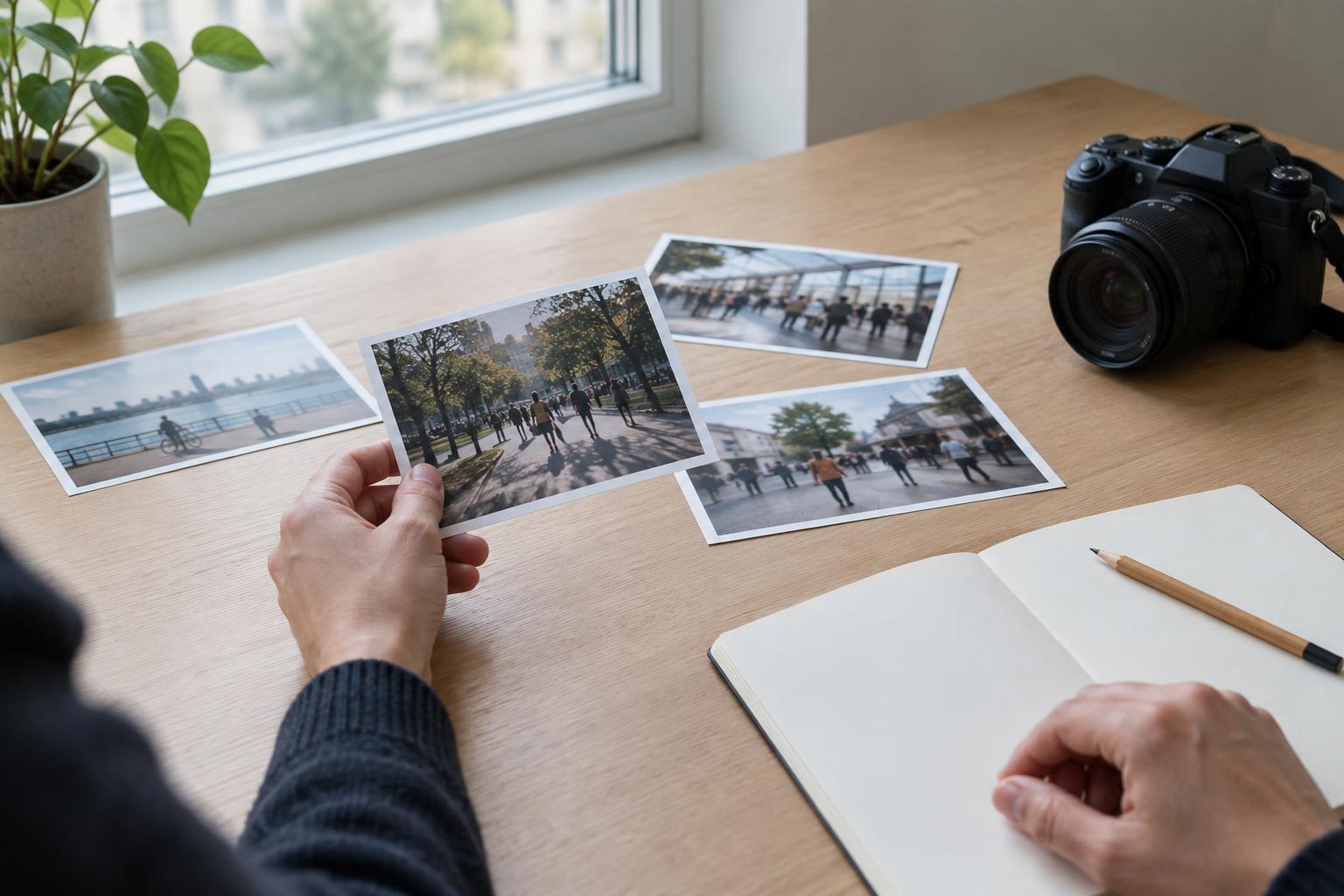
Give the reader information the photograph cannot
A documentary photograph can show a person carrying a box, a room after an event or a line forming outside a building. It cannot, by itself, establish why someone acted, what they felt or what happened outside the frame. A useful caption bridges that gap with facts the photographer or editor can substantiate. It identifies what matters in the scene and adds enough context for a reader to understand its place in the story.
Begin with the essentials: who or what is pictured, where the scene takes place and, when it matters, when it was photographed. Then ask which additional fact would make the image more intelligible. The answer might be the name of an event, the purpose of a location or a detail established through a conversation or record. A caption does not need to contain everything you know. It needs to help readers understand this image without promising more than the evidence supports.
Separate what you saw from what you learned
Observation and context come from different sources. You may directly observe that a person is stacking chairs. You might learn from that person that the room is being prepared for a meeting. Keep a note of which details you witnessed and which came from someone else, a sign, a schedule or another source. That distinction makes it easier to check a caption later and to attribute a detail when its source matters.
Consider a hypothetical photograph of someone carrying bags out of a building. “A resident carries bags out of the building before leaving for work” adds a reason the image cannot prove. If the person told you where they were going, you could write, “A resident carries bags out of the building before leaving for work, according to the resident.” If you did not ask, describe only what you can establish: “A person carries bags out of an apartment building.” The less specific version is more useful than a vivid but unsupported explanation.
Names, roles and dates also require care. A person wearing a uniform may not hold the role you assume; a photograph made in the morning may be published long after the event. Check these details against your notes rather than filling gaps from appearance or memory. If you cannot confirm an identity, a precise description of the visible action may be enough.
Describe actions without assigning feelings or motives
Expressions and gestures invite interpretation, but they are not reliable evidence of an inner state. “Worried residents wait for answers” tells readers what the people feel. “Residents wait outside the meeting room” reports an action. If a resident has said they are worried, attribute the statement to that person rather than extending it to everyone in the frame.
Motive deserves the same restraint. Someone standing at a demonstration may support its aims, oppose them, be working there or simply be passing through. Someone looking away from the camera may be distracted rather than reluctant to be photographed. When motive is central to a story, ask about it and make clear whose account you are presenting. Otherwise, let the visible action and verified circumstances carry the caption.
Careful language does not have to be flat. Specific, observable details can make a caption vivid: a worker folds a table, a participant holds a handwritten sign, or a child watches from a doorway. Choose details that help explain the scene, not details that merely encourage readers to build a dramatic story around a stranger.
Make uncertainty visible and protect the subject
Not every gap can be closed before publication. If a detail is important but uncertain, qualify it plainly or leave it out. “The building appears vacant” is different from “The building is vacant,” though even a qualified claim should have a reason to be included. Avoid vague phrases such as “reportedly” when you can identify who supplied the information. If a contested account matters, explain whose account it is without presenting it as something the photograph proves.
Accuracy also includes considering what identification could do to a subject. A full name, exact address or personal circumstance may be unnecessary to understand an image, particularly in a sensitive setting. Do not turn a visible detail into an unsupported claim about someone’s health, legal status, income or family life. Before adding identifying context, ask whether it is verified, relevant and appropriate to publish.
Use a short verification pass before publication
Read the caption once without looking at the photograph. Does it make a claim you could trace to an observation, a note or an identified source? Read it again with the image. Does it describe the right people and action, and could a reader mistake background context for something visible in the frame? Check names, locations and timing against your records. If the image belongs to a sequence, make sure the caption does not borrow an action from a different frame.
Finally, remove words that explain a person’s mind without evidence: “hoping,” “fearing,” “determined,” “unaware.” Replace them with a verified statement, an attributed account or a description of what is visible. A strong documentary caption does not solve every ambiguity in an image. It gives readers dependable facts and leaves room for what the photograph cannot tell them.